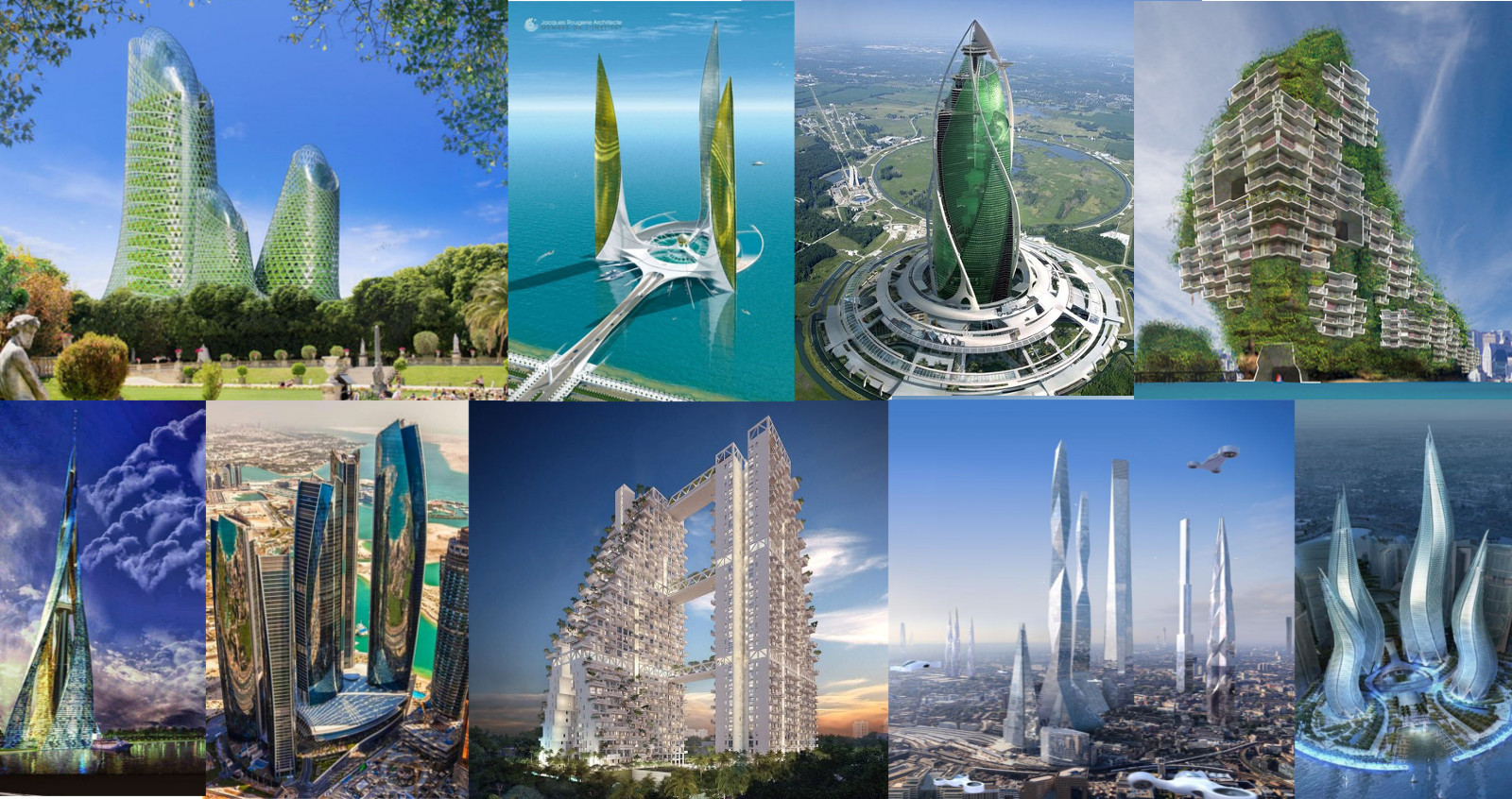
Truly huge mega cities are “arcoplexes,” or residentially, commercially and industrially specialized arcologies that link to each other to create a unified, futuristic ecosystem.
An Arcology, a blend of “architecture” and “ecology”, is a field of creating architectural design principles for very densely populated, ecologically low-impact human habitats.
The concept has been primarily popularized, and the term itself coined, by architect Paolo Soleri.
An arcology is the result of said discipline, and is a thing with the following three attributes:
- High population density.
- Constructed as a single building.
- Self-contained in regards to energy, amenities and waste reclamation.
Imagine a skyscraper. Every five or so floors, there is an entire floor dedicated to the inner workings of the floors above it. This is called a deck. The deck level houses all power lines, plumbing mains and anything else that needs to work properly for life to be livable with all the modern conveniences. Now make the skyscraper cover the ground area of a small city or a large town and realize that the decks number in the triple digits. There’s the ideal description in a nutshell.
LightCities are in fact Arcoplexes which are residentially, commercially and industrially specialized Arcologies that link to each other to create a unified futuristic ecosystem. We envision each Arcoplex to be made up of 8 to 10 Archologies. Each Arcology will consist of approximatively 50,000 people.
A LightCities Arcoplex will be designed for a population of 500,000 people.
Examples of Arcologies:
Masdar City
In Abu Dhabi in the United Arab Emirates is a planned city, designed by Foster +
Partners. It’s called Masdar City, and will rely solely on solar and other renewable energy sources, with a principle of zero-carbon, zero-waste.
Six square kilometres have been set aside for the development, which will provide homes to 45,000 to 50,000 people and 1,500 businesses, including the International Renewable Energy Agency and the Masdar Institute of Science and Technology. Cars will be banned, with transport instead provided by mass transit and personal rapid transit systems.
Power will be provided by a solar plant, wind farms, and geothermal energy, and the community also will house what’s planned to be the world’s largest power plant. A solar-powered desalination plant will provide water, and 80 percent of the water used will be recycled, with wastewater reused “as many times as possible” for the purposes of crop irrigation. Biological waste will be turned into fertiliser and used as a power source, and industrial waste will be recycled or repurposed.
Crystal Island
In Moscow, Russia, Norman Foster has also designed another arcology — the Crystal Island. If the plans come to fruition, then it’ll have 2.5 million square metres of floor space and a heigh of 450 metres, making it the six tallest building in the world, and the largest structure in terms of floor space.
The construction will be covered by a breathable skin, which can be sealed in the winter to provide insulation against the biting cold of the region. In the summer, the same skin can be opened up to allow for ventilation, but to keep the sun’s rays off the interior. It’ll be powered by external solar panels and wind turbines.
Inside Crystal Island, there are planned to be a exhibition and performance space, cinema, hotel and apartment complexes, along with office and retail space, and a school for 500 international students.