
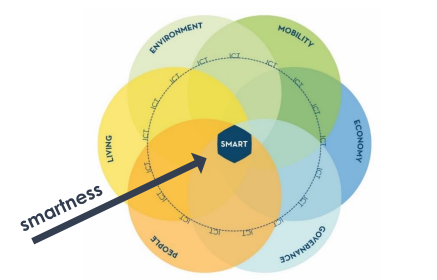
ASCIMER’s Smart City Working definition
“A Smart City is an integrated system in which human and social capital interact, using technology-based solutions. It aims to efficiently achieve sustainable and resilient development and a high quality of life addressing urban challenges on the basis of a multistakeholder, municipality based partnership.”
This definition stablishes a strong basis for the city and the objetives cities must achieve, defining the tools and main actors involved in the Smart City concept. These are the three main goals that a Smart City pursues:
1. Improve the efficiency of the city as a system
Smart City initiatives seek the efficiency of the existing and new infrastructure through: – Interconnecting the different infrastructure components, services offered and people working with them. – Reducing the costs in the long term, thanks to the monitoring and information sharing.
2. Achieve a sustainable & resilience development.
Although linked with efficiency, sustainability has a broader scope. The consensual definition of sustainable development is a “development that meets the needs of the present without compromising the ability of future generations to meet their own needs”.
Resilience adds to that sustainable development the capability of recovering fast and of minimising harm after an unexpected event or disaster takes place in the city.
3. Increase the quality of life of its citizens.
Increasing the quality of life of its citizens constitutes a key objective of the Smart City. When working with the city there should never be forgotten that the final end of the city itself are its inhabitants. Whenever a Smart City initiative is developed, its ultimate target ought to be to improve the quality of life of the citizens.
DIMENSIONS
Analyzing the urban environment, research works deal with a different number of fields to frame the city. We have identified in the reviewed literature that they can all be allocated within six main City Dimensions: Governance, Economy, Mobility, Environment, People and Living.
They represent the specific aspects of a city upon which Smart Initiatives impact to achieve the expected goals of a Smart City strategy (sustainability, efficiency and high quality of life). Technology itself it is not considered an action field, but an enabler that improves the efficiency of the projects.
A project is smarter when it integrates the higher number of dimensions. The approach should be as integrated and holistic as possible
SMART GOVERNANCE
Smart Government makes use of available technology to be aware of -and coordinate with the activities carried out by other municipalities, achieve synergies through collaborations with other stakeholders and reach out citizens needs in order to improve both, public services, and confidence in the public institutions.
SMART ECONOMY
An urban economy is considered to be a Smart Economy when the sector gathers innovation and productivity to adapt to the market and workers’ needs to enhance new business models and a resilient global model for competing both locally and globally.
SMART MOBILITY
Smart Mobility pursues to offer the most efficient, clean and equitable transport network for people, goods and data. It leverages the available technologies to gather and provide information to users, planners and transport managers, allowing the reshaping of urban mobility patterns, of planning mechanisms and the enhancement of multimodality by improving the coordination and integration of different transportation modes.
SMART ENVIRONMENT
Smart Environment uses data collection from utility networks, users, and air , water, and other city resources in order to establish main areas of action in urban planning and city infrastructure planning as well as to inform urban services managers to achieve a more efficient and sustainable urban environment while improving the citizens’ quality of life.
SMART PEOPLE
A Smart City needs the citizen to participate in order for the incoming initiatives to succeed. The existence of citizens able to participate wisely in smart urban life and to adapt to new solutions providing creative solutions, innovation and diversity to their communities is needed. Education appears as the main tool to improve this dimension, as well as initiatives to retain creative profiles.
SMART LIVING
As a conclusion, Smart Living is considered the wise management of facilities, public spaces and services using ICT technologies to put focus on improving accessibility, on flexibility of uses, and on getting closer to the citizens´ needs.